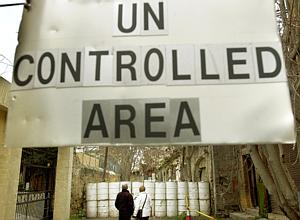
A photo of a couple standing in front of the barrels that divide the Greek and Turkish Cypriot controlled areas at the UN buffer zone in the divided capital of Nicosia, Cyprus, on Friday, Feb. 17, 2006.
Tassos and Annan to meet in Paris
BY ANDREAS HADJIPAPAS
PRESIDENT Papadopoulos and UN Secretary-General Kofi Annan will meet in Paris on February 28 to explore ways of reviving the stalled Cyprus peace talks.
The crucial issue is whether the UN chief will be persuaded to appoint a special envoy for Cyprus who will shuttle between the two sides in order to see if there is enough common ground allowing the UN to launch a new initiative.
So far, the Secretary-General has been reluctant to do so, noting that there remained a wide gap between the sides.
He now wants to make sure any new effort will have reasonable chances of success.
Presidential Under-secretary Christodoulos Pashiardis said yesterday the President was "ready to listen but also to make concrete suggestions." This was seen as an indirect reply to critics, who have been claiming Papadopoulos is not keen to resume the peace process.
Papadopoulos, who has dismissed the Turkish "action plan" announced by Foreign Minister Abdullah Gul last month, is expected to present counter-proposals, involving the return of the deserted town of Varosha and the joint operation of Famagusta port under EU supervision.
The official announcement about the forthcoming Paris meeting said Papadopoulos and Annan had agreed to meet "in order to review and take stock of the situation in Cyprus and discuss ways of moving forward the process of reuniting the island."
Pashiardis said the two men would examine "effective ways of preparing the ground for the launching by the United Nations of a new effort to conduct meaningful talks with serious prospects of success".
Foreign Minister George Iacovou said that as a means of preparing the ground, the S-G could either appoint a resident representative, or send a high ranking UN official to the island periodically to carry out proximity talks between the sides and report back to him.
He stressed that this did not mean new talks were "imminent."
Reports suggest the aim is to see whether settlement talks, which grounded to a halt two years ago, can get off the ground by the summer, even th0ough most observers believe chances of a possible breakthrough will be better after the Turkish elections next year.
Iacovou said the important thing was to see whether the Turkish side was ready for "substantive" negotiations, after agreeing to consider "substantial changes" to the Annan Plan.
The Greek Cypriot side has already submitted to the UN a detailed list of changes to the Plan, which was rejected by the vast majority of Greek Cypriots in the May 2004 referendum.
The National Council will be meeting today under President Papadopoulos to review developments, following requests by the Opposition who have been expressing concern about the lack of movement, stressing that the protracted stagnation helped cement the island’s division. Iacovou said the Paris rendezvous showed that "there is mobility."
Papadopoulos is likely to tell Annan that any new UN brokered peace process musts see the full involvement of all five permanent members of the UN Security Council, not just of Britain and the US.
He also wants the European Union to play an active role in any new negotiations, since he insists that a settlement must be based on Security Council resolutions and the principles upon which the EU is founded.
President Papadopoulos leaves for Vienna on Sunday for a two-day working visit to Austria, which holds the rotating EU presidency.
He will meet Chancellor Wolfgang Schussel and Federal President Heinz Fischer, to explain Cyprus’s views on EU matters and efforts to resolve the problems of the divided island.
Turkish Cypriot leader Mehmet Ali Talat said yesterday he was ready to resume negotiations "on the basis of the Annan Plan".
He added: "The Secretary General will probably decide after his meeting with Mr Papadopoulos whether he will take a new initiative. I believe the S-G will take this initiative, if the Greek Cypriot leader really desires this, if the meeting is not just for creating positive impressions in view of the election period."
Greek Prime Minister Costas Caramanlis, speaking during a brief visit to Germany, said his government’s policy on Cyprus and other national issues "does not change, is stable."
He said Greece was willing to contribute to efforts to find a just, workable and sustainable solution to the Cyprus problem. The solution should conform with international law, UN resolutions and the principles and values of the European Union, of which Cyprus is already a member.
Meanwhile, US deputy assistant Secretary of State Mathew Bryza has again put off his planned visit to the island, originally set for last summer. Although he said in Brussels he hoped to visit the region later this month, the US Embassy informed the Foreign Ministry this week that Bryza would probably be coming "some time in the spring."
Cyprus Weekly, 18 - 25 February 2006
Cyprus protests to UN over Turkish violations of air space
Cyprus’ Permanent Representative at the United Nations, Andreas Mavroyiannis, has protested to the UN over new violations of international air traffic regulations and the national airspace of the Republic of Cyprus by Turkish military aircrafts, that took place between November 9, 2005 and January 4, 2006, calling for their immediate cessation.
In a letter sent to UN Secretary General Kofi Annan on January 11, 2006, that circulated yesterday as an official UN document, Cypriot Ambassador stressed that “Turkey’s policy of persistently breaching international law and defying international rules and regulations gravely jeopardizes the safety of international civil aviation and the stability of the region”.
He also noted that “Turkey’s systematic attempts to undermine the sovereignty and unity of the Republic of Cyprus by promoting an illegal secessionist entity, arrogating, inter alia, to itself the right to have a national airspace, further complicates the efforts to build trust and confidence between the two sides and resume negotiations”.
Ambassador Mavroyiannis added that “such actions are yet further evidence of Turkey’s sole objective, namely to consolidate the existing division of the island and maintain thus its military presence in Cyprus in perpetuity”.
Meanwhile, Government Spokesman George Lillikas has said “The Cyprus issue is a European problem as well, and a European problem for Turkey.”
He added that “it is up to Turkey to stop having the Cyprus issue as an obstacle for its EU accession course”.

From The Turkish Daily Hurriyet
Some of the highlights of the Ankara document sent to Annan are as follows:
*****A call for renewed efforts to work on the Annan plan for Cyprus from all sides. The Annan plan was rejected by the Greek side of the island in a referendum, but the Ankara document calls for its re-enlivening.
*****A call for the EU to bring about the promises of direct trade and aid made to Northern Cyprus prior to the Greek referendum.
*****A call for preparations to be made in order to bring about direct trade possibilities with Northern Cyprus for any country which wishes. Isolationary measures placed on Northern Cypriot ports and airports should be lifted according to this too.
*****A reassurance that, following these measures, restrictions against Greek Cypriot use of Northern Cypriot ports and airports will also be lifted.
Diplomatic timing crucial
According to diplomatic sources, both the US and England have put their full support behind this document.
North has ten days to fix power plant
By Jean Christou
THE ELECTRICITY Authority of Cyprus (EAC) said yesterday it would be very difficult to supply the north with electricity beyond the ten days the Turkish Cypriot side asked for.
Responding to reports in the Turkish Cypriot press that the supply from the south might be needed for a month, Costas Gavrielides, the EAC’s Customers Service Assistant Director said that would be difficult.
“We are not in a position to give them electricity for a month,” he said. “We agreed ten days. What we are giving them is at the expense of our own system. We don’t have more to spare. If we can give it to them we will, but it shouldn’t be taken for granted that we can supply for an extended period of time.
“It depends on whether we have the supply or not. It’s not easy. We understand they are in a difficult situation and we want to help for as long as we can.”
Turkish Cypriot ‘Minister of Agriculture and Forestry’ Huseyin Oztoprak said authorities might continue to purchase electricity from the south for a period of up to a month, pending the repair work at the Teknecik power plant.
The Turkish Cypriot side called for help late on Wednesday after an explosion disabled the power station in Kyrenia. The north had been experiencing problems for some time, according to Turkish Cypriot press.
An 80 mega watt connection for a period of seven to ten days until their problems were fixed.
Supplying the north is expected to cost between £600,000 and £800,000.
President Tassos Papadopoulos said yesterday the government would have given the electricity even if the Turkish Cypriot side could not pay.
“We would still have given it to them for free,” he said.
However that this would create problems with the competition commission as such a move would be regarded state grant and the EAC would have to pay a fine.
“Our compatriots needed help, we had the capability to help them, why shouldn’t we?”
Between 1974 and 1996, the Greek Cypriot side supplied all the electricity needs of the north until the Kyrenia station was up and running. This had cost the EAC a total of $162 million for the 22-year period. The money was never paid by the Turkish Cypriot side.
Turk Generals insisted some troops must stay – Tassos
Turkish Generals insisted that some Turkish troops should stay in Cyprus, even after a settlement based on the Annan Plan, and UN officials acting as "arbitrators" quickly accepted their demand, without bothering even to inform the Greek Cypriot side about the change.
Earlier versions of the Annan Plan, the product of negotiation, provided that all Turkish troops would pull out of the island by stages.
This was revealed by President Papadopoulos as he spoke to foreign correspondents at a CNA-sponsored luncheon this week.
Annan Plan V, drafted at Burgenstock in April 2004, was rejected by the overwhelming majority of Greek Cypriot voters, while approved by Turkish Cypriots.
Papadopoulos, who led the Greek Cypriot side at the meetings, said he was told by Secretary-General Kofi Annan and other UN officials that the continued presence of Turkish troops on the island was a "red line" for Turkish generals."
As a result, a proviso was incorporated in the final draft, stating that 650 Turkish troops would stay on the island, even after a final settlement establishing the United Republic of Cyprus.
Papadopoulos noted that earlier versions of the Plan, the product of negotiations, called for the complete pullout of the estimated 35,000 Turkish troops occupying northern Cyprus since 1974.
When Papadopoulos saw the new addition, he complained to Annan and other UN mediators telling them: "Why didn’t you ask me? Where is the give and take?" which is the basis of any negotiation.
The President told journalists that the Turks, through high ranking diplomat Ugur ziyal, had presented a list of eleven demands at Burgenstock, to be incorporated in the UN blueprint.
He said the UN satisfied "ten and a half" of the Turkish positions.
When he told UN envoy Alvaro de Soto about this, the Peruvian diplomat reportedly told him that the UN satisfied only eight of the eleven Turkish demands.
Turkey must comply with its Cyprus obligations, says French PM
By Angelos Marcopoulos
Turkey has no option but to meet its obligation in connection with Cyprus and respect human rights it was stressed by French Prime Minister Dominique de Villepin and other senior European leaders in exclusive statements to The Cyprus Weekly during a series of political gatherings here.
``This year we shall see how Turkey deals with its obligations,’’ de Villepin said. ``The new year must be an active and useful one because France, and Europe, have to defend their values on human rights and peace in the world,’’ he added.
The French leader was replying to a question whether Turkey would be convinced to meet its own obligations to the EU in the coming year following the fact that the EU, and Cyprus, met all their obligations to it in 2005.
The question referred of course, to the repeated statements from Turkish Prime Minister Recep Tayyip Erdogan and other senior Turkish leaders that Turkey will not apply the EU protocol demanding the opening of Turkish sea and air ports to Cypriot ships and aircraft.
Villepin’s position was made more specific in a subsequent statement to The Cyprus Weekly by the French Foreign Ministry’s spokesman Jean-Baptiste Mattei.
"They (Turkey) undertook commitments and they should respect them...In 2006 there will be a series of (EU) rendez-vous with Turkey on Cyprus,’’ he said.
It was significant that Villepin’s statement came shortly after the European Court of Human Rights issued a series of judgements condemning Turkey for gross violations of human rights, including murders, disappearances, torture, oppression of free speech, etc., which revealed that Ankara continues to show contempt to a CoE’s ministers’ resolution which vainly asks Turkey to cease tolerating grave crimes committed by its security forces.
De Villepin’s stance was fully backed by Rene van der Linden, the Dutch President of the Parliamentary Assembly of the Council of Europe and Catherine Colonna, the French Minister for European Affairs.
"I hope that all involved will be wise enough to stick to agreements and meet all revelant expectations,’’ van der Linden told The Cyprus Weekly in response to a question dealing with Erdogan’s statement.
"They (Turkey) certainly "Have to apply’’ the extension of Custom Union to Cyprus was Colonna’s comment.
UN Resolutions must be fully implemented - Chirac
In another important statement for Cyprus this week French President Jacques Chirac said that all UN resolutions must be fully implemented.
Calling for a "new start’’ and the "relaunch of a political Europe, in a multipolar world", Chirac said that "France is determined to act more strongly than ever in order to find solutions to many conflicts".
This should be done "with due respect to law, and the law is not a variable geometry,’’ he said, stressing that "all UN Security Council resolutions must be fully implemented.’’
Giving further backing to Chirac’s words French Foreign Minister Douste Blazy stated that ``France’s ambition in 2006 is for the EU to play a political role in all efforts to settle conflicts.’’
British MP condemns Cherie Blair’s involvement in property case
11/01/2006
British MP Roger Gale (Conservative for North Thanet) has condemned the involvement of the Prime Minister’s wife, Cherie Blair, in a property case relating to occupied Cyprus. Speaking at the House of Commons on Monday, following receipt of an answer by Minister Douglas Alexander to a written parliamentary question, Mr Gale said the Downing Street position seemed inconsistent with the Foreign Office position with regard to property matters in occupied Cyprus. He then explained that it was “not good enough for the Prime Minister’s wife, acting in any ‘professional’ capacity, to defend the interests of those exploiting stolen and occupied property in the northern part of the island of Cyprus” while the Foreign and Commonwealth Office was declaring that the British Government warned British citizens of the risks of purchasing property there. Mr Gale also noted that Cherie Blair’s involvement in a case “allegedly funded by a former North London Turkish Cypriot Labour Councillor and seeking to defend the interests of British nationals who claim to ‘own’ a villa built on land belonging to a Greek Cypriot refugee, is clearly designed to bestow legitimacy upon an illegal regime and upon the illegal development of the villas that are now smothering the northern part of the island”. “Once again it would seem that venal self-interest is taking precedence over the legitimate rights of those who have had their properties illicitly taken from them”, the British MP concluded.
Mrs. Theresa Villiers: If he will make a statement on progress towards a settlement which will reunite Cyprus.
Mr. Jack Straw: As the UN Secretary-General noted in his report of last December, progress toward a solution on Cyprus has been negligible at best. We believe that a comprehensive solution can only be achieved under United Nations auspices, but the UN reported a widening gap and little confidence between the two communities over the past year. Ultimately, both communities have to demonstrate the courage and flexibility required to resume negotiations towards a comprehensive settlement, and we shall play our part in that.
Mrs. Theresa Villiers: There is a development boom in northern Cyprus, much of which is taking place on land that its owners fled from, as refugees, after the Turkish invasion. Will the Secretary of State strengthen the advice on the Foreign Office website urging British tourists and holidaymakers not to buy property in northern Cyprus that might have been stolen from its Cypriot owners?
Mr. Jack Straw: The advice that we give at the moment is appropriate but of course, we will always keep it open to review. This is a very complicated issue that goes back many decades. We are seeking to help bring both parties together, which is one reason why I worked so hard to open negations with Turkey on 3 October on membership of the European Union. Only when Turkey, Greece, Cyprus and the two communities recognize that their mutual interests are stronger than their historic antagonisms will we get a settlement.
Belgium, which currently holds the OSCE chair, restated the need for Turkey to sign the Ankara protocol extending the EU's customs union to all ten new member states including Cyprus. "Resolving this lasting problem is a precondition for Turkish EU membership," Belgian Foreign Minister Karel De Gucht told Cypriot journalists.
"We have been of the opinion that the solution of the Cyprus problem should not necessarily be a precondition for opening accession negotiations, which we decided in October in Luxembourg but it certainly is a precondition for membership," added De Gucht. "We hope that the problem is solved as soon as possible."
Following Dutch and French rejection of the proposed European constitution, a growing number of leading EU politicians argued that enlargement should be put on hold for Turkey.
Turkey, a Muslim country of 72 million people, has been trying to enter the European Union, and its predecessors, for over 40 years. Objections included the state of human rights, treatment of ethnic and religious minorities such as the Kurds, and Ankara's refusal to recognize the Republic of Cyprus or the Armenian genocide. Negotiations will last a minimum ten years, with no guarantee of membership, and foresee the eventual adoption of the euro.
For its part, Turkey, too, is increasingly worried as to the future of enlargement. Ankara is under immense pressure to finally carry through on its commitments to implement economic and political reforms and expand its customs union with the EU to include all ten new Member States, including Cyprus.
EU Enlargement Commissioner Olli Rehn has many times suggested that Turkey will 'soon' sign the protocol. Turkish officials, however, have only put pen to paper on an additional declaration to the Ankara Protocol stating that the document does not entail Turkish recognition of Cyprus.
"Clearly for us that there should be an early ratification of the Protocol. It should work in practice. Not only legally, but also in practice," said De Gucht on his visit to Cyprus earlier this week.
Launching its plans for Austria's Presidency of the EU, Chancellor Wolfgang Schüssel warned that talks with Turkey will be hard. Austria held out to the last minute before agreeing to opening of EU negotiations with Turkey.
 War and Cultural Heritage
We are paying Mrs. Blair gbp 200,000.
Getting her on the Turkish side...
(The Mail on Sunday Via Thomson Dialog NewsEdge)
Cherie Blair was last night at the centre of a fresh row over her business affairs after a Mail on Sunday investigation uncovered new details about her latest high profile legal case.
REPORTS in a British newspaper that the Turkish government is paying part of Cherie Blair’s £200,000 Sterling fee to defend the Orams shows that the case has political significance despite protest to the contrary by Downing Street, the government said yesterday.
Britain’s Mail on Sunday went undercover to investigate the case of Linda and David Orams, who are attempting to justify their possession of land in the north belonging to Greek Cypriot Meletis Apostolides.
The British Prime Minster Tony Blair’s barrister wife is taking part in the defence of the couple, who are appealing a Nicosia court decision ordering them to demolish the £160,000 villa they built on Apostolides’ property in Lapithos.
As the Nicosia court cannot enforce its decisions in the north, the case has been accepted by the UK courts.
Cherie Blair’s law firm Matrix, was brought in by the Orams’ Turkish Cypriot lawyer Hassan Vahib, 44, a property developer and former Labour councillor in London, who is also one of the parties paying the couple’s legal costs.
Downing Street has insisted that Blair is acting in her professional capacity as a lawyer but a reporter from the Mail on Sunday discovered otherwise while posing as someone interested in buying property in the north.
The paper said it spoke to the operations manager of Vahib’s property firm Troy Lake UK (Cyprus) Ltd, Firtac Ortac, who confirmed the firm was contributing to Cherie Blair's costs and that the reason for hiring her was because of her political influence.
“At a meeting with an undercover Mail on Sunday reporter he said: 'We are paying her more than £200,000. The clients are not paying. We are. We can afford it and we have much ourselves to gain. When Mrs Blair wins, it will set a precedent and the market will rocket.'
“Ortac also said that the hiring of the Prime Minister's wife was, for them, a political act, the paper said: “We have about 25 lawyers working for us, so there is no shortage of legal brains. But you see the North-South dispute is also very political.
“They (the Greek Cypriots) have made it political, so now we get political too. What can be better than getting the wife of the British Prime Minister on our team? She is a noted human rights lawyer too, so simply getting her involved and on the Turkish side is fantastic,” he added.
Ortac claimed that the Turkish government was also paying Blair because they were 'playing a political game' and boasted that Vahib was in regular contact with Turkish President Ahmet Necdet Sezer, the paper said.
Blair agreed to take the case following hush-hush meetings with Vahib and the Orams in Istanbul last May. “Cherie Blair spent three days in the city, during which she was a guest of the British consulate. However, she demanded that the reason for her trip be kept confidential,” it added.
Another property developer, several of whom are involved in financing the case, said they were hoping she could use her political influence in the case. “What can be better than getting the wife of the British Prime Minister on our team?” said one. “When Mrs Blair wins, it will set a precedent and the market will rocket.”
Government spokesman Kypros Chrysostomides said it was obvious from the report that those who hired Blair hired her specifically in order to exploit her politically as the wife of the British Prime Minister.
“What is particularly important is that someone appears to admit that the Turkish Government will pay all of part of the fees of Mrs Blair,” he said.
“Perhaps they believe by hiring her they might be able to influence the course of British justice. Is the impression not created that by accepting such a politically loaded case, Mrs Blair has given insufficient weight to her position as the wife of the British Prime Minister?”
Chrysostomides said it should also be borne in mind that the British Foreign Ministry has on many occasions published warnings to Britons about the legal minefield of purchasing property in the north. “It seems Mrs Blair has not taken these warnings into consideration,” he said.
The Orams told the Mail on Sunday that they had agreed with their legal team not to speak until after the conclusion of the case.
“All I can say to you now is that we are extremely confident of winning,” Linda Orams said.

