 Last week, I had mentioned that Larnacaairport.com directs you to the website of the "Ministry of Economy and Tourism" of North Cyprus. Well, what I found out this Sunday morning completely shocked me. Paphosairport.com, Nicosiaairport.com, and Larnacaairport.com are all registered to the same individual that goes by the name of Ata Atun, and all addresses direct you to the website of the "Ministry of Economy and Tourism" of North Cyprus. Is the Nicosia government aware of this and if so, does it not realize that it can take legal action?
Monday, March 27, 2006
The sheer incompetence of it all!
Last week, I had mentioned that Larnacaairport.com directs you to the website of the "Ministry of Economy and Tourism" of North Cyprus. Well, what I found out this Sunday morning completely shocked me. Paphosairport.com, Nicosiaairport.com, and Larnacaairport.com are all registered to the same individual that goes by the name of Ata Atun, and all addresses direct you to the website of the "Ministry of Economy and Tourism" of North Cyprus. Is the Nicosia government aware of this and if so, does it not realize that it can take legal action?


Friday, March 24, 2006
Cyprus Landmines

A recent photo of a warning sign in three languages, Greek, Turkish and English, is seen at a minefield in Nicosia, the capital of Cyprus. A multi-national team of ordnance disposal experts are working to clear landmines at the U.N. controlled strip of land that splits the island between its ethnic Turkish and Greek communities.
Rice Remarks with Greek FM
The Foreign Minister of Greece, Dora Bakoyannis, paid a visit to Washington today where she discussed several issues of mutual interests, including such matters as Turkey’s EU accession and the Cyprus problem with US Secretary of State Condoleezza Rice. After the meeting, the two held a joint press conference:
Foreign Minister Bakoyannis will take part in observance of the Greek National Holiday at the White House with President George W. Bush.
SECRETARY RICE: Good afternoon. I would like to welcome Greek Foreign Minister Bakoyannis -- Dora -- to the State Department and here to Washington, D.C. This is her first trip to Washington, D.C. as Foreign Minister. I have to say that I'm a great admirer of the work that she did as the Mayor of Athens, a city that is near and dear to the hearts of most people around the world, and she has been Foreign Minister now for a little over a month and it's delightful to have her here in Washington.
We've had a great opportunity to discuss our strategic partnership with Greece. This is a relationship that is first and foremost, of course, based on values. It is a relationship that recognizes the seminal role of Greece as a cradle of those values and recognizes that in the modern era in which we find ourselves now with so many challenges that Greece is a stalwart partner in the spread of democratic values, whether it be in Greece's work in the Broader Middle East Initiative, in which we've all been involved, promoting stability and prosperity in the Balkans, fighting terrorism and, of course, seeking the reunification of Cyprus on the basis of democratic values.
We have had a very useful discussion of these issues, as well as the concerns of NATO in Afghanistan, in the training mission in Iraq, in Sudan. In other words, it's been a very broad and good discussion and I look forward to many, many more with Dora over the years.
So welcome and the floor is yours.
FOREIGN MINISTER BAKOYANNIS: Thank you, Condi, and thank you for the nice words about Athens. We had a very fruitful and constructive meeting with U.S. Secretary of State Condoleezza Rice and I thank her for this invitation. The U.S. and Greece enjoy an historic relationship. It is the relationship between the world's most powerful democracy and the world's oldest democracy, the birth place of our shared values and ideals.
In our talks we sought effective ways of enhancing this relationship. We discussed developments in the western Balkans, a region of strategic importance for Greece, where we have a strong political and economic presence. We agreed that the future of the western Balkans lies in Europe, that any solution to the problem of Kosovo may take into account all parts concerned and the stability of the region.
We believe in a united bicommunal Cyprus. As I had the opportunity to stress to my colleague a solution to the Cyprus problem will only be viable if it is based on relevant Security Council resolutions, the UN Secretary General's sets of proposals and the norms of the EU to which Cyprus belongs.
We both support Turkey's European aspirations, but I must say that Turkish European future lies in its own hands on the application of the European norms and practices, both inside Turkey and in their relationships with the neighbors, particularly Greece and Cyprus.
We discussed all major international issues, especially the Middle East, Iran and, naturally, Iraq. Greece enjoying a 14 centuries-long relationship with the Islamic world is well suited to play a role in the better understanding between the West and Islam.
Let me conclude by saying that I had the pleasure of inviting Secretary Rice to Greece and she -- and I was very happy that she accepted my invitation. Thank you very much.
MR. MCCORMACK: We'll take two questions a side. The first question to Anne Gearan from Associated Press.
QUESTION: Good afternoon. A double-barreled question on Iran, Madame Secretary. First, are you any closer today to winning the support of Russia and China for a statement at the Security Council? Are you looking for an alternative to that statement if you can't reach consensus?
And secondly, is there anything new to report on whether or not the United States will hold talks with Iran on Iraq?
SECRETARY RICE: Thank you, Anne. Let me start by saying that the United Nations Security Council now has the Iran dossier. That was the agreement of the ministers when we met in London, the P-5 + 1 when we met in London at the end of January. We agreed to wait for the report of Mohamed ElBaradei, the Director General of the IAEA, at the Board of Governors meeting March 6th through 8th, and then we are now taking that up in the UN Security Council.
There is no time for delay in taking up this issue. A presidential statement which will reaffirm the understandings that we had at the London meeting, the understandings that under-girded the February 4th resolution in the Board of Governors for which a number of countries, including Russia, voted. We need to have this statement and to make clear to the Iranians that the international community is united in demanding that Iran return to a posture that is consistent with its NPT obligations and consistent with the international community's need to know that Iran is, indeed, conducting a peaceful nuclear program. There is an erosion of confidence in Iran on this point because they lied to the IAEA for 18 years. They do want a civil nuclear program. That's fine. They can have one, but not with enrichment and reprocessing on Iranian territory. They need to suspend the activities in which they're engaged and return to negotiations.
There shouldn't be any delay. There can't be any stalling. The international community has got to act. People are looking to the international community to show that this can, indeed, be dealt with diplomatically. And we are committed to a diplomatic solution, but it has to be dealt with.
On the matter of what we might do with the Iranians in terms of talks, as I've said a number of times, this authority for Ambassador Khalilzad has been a standing authority for some time and we have found it useful from time to time to talk about concerns on the security side, to raise our concerns on the security side, and he has that standing authority. Those talks would be limited to Iraq and limited to security issues. Ambassador Neumann has similar authorities in Afghanistan.
QUESTION: Thank you. Good afternoon, ladies. I have a question for Madame Secretary. In one way this is a follow-up of a question I put last year of this day. We are talking about strategic partnership between the two countries. Last year, the same expression in answer to me. Could you please give me the substance of this partnership, of this strategic (inaudible)? Thank you.
SECRETARY RICE: Thank you. What does it mean to be a strategic partner? It means first and foremost that you share the desire to solve problems in the international system and to come up with solutions and to execute those solutions together on the basis of shared values, on the basis of common concerns.
It doesn't mean that we always agree on every element concerning a particular problem. But it does mean that Greece and the United States, from the strongest possible basis of shared values, from our alliance in NATO, from the work that we are doing together in the Balkans, that we are now reaching past that to the broader Middle East where, as Dora said, Greece has a long history of relations with the Muslim world and is therefore an anchor for any outreach to the Muslim world and the efforts to help to support those who want a democratic future.
It means that we work together on the NATO efforts in Afghanistan. It means that we work together on the NATO efforts for training in Iraq. So I see it as a declaration of, first and foremost, our shared values but also our desire to use that very strong basis to solve common problems together. Even if from time to time we may not agree about everything, this is an excellent relationship and the United States is delighted to have such a good friend and partner in Greece.
QUESTION: Thank you. Next year I am not going to --
SECRETARY RICE: Next time you can ask the same question. (Laughter.)
QUESTION: Madame Secretary, you spoke with Afghan President Karzai today regarding the case of Abdul Rahman. What assurances did he give you on this? Are you -- have you been assured that Mr. Rahman's life will be spared and what would be a satisfactory outcome as far as the United States is concerned? And some European governments have weighed in on this as well. I'd be interested to hear the Greek view, if you care, Madame Foreign Minister.
SECRETARY RICE: Let me start from the point of view that there is no more fundamental issue for the United States than freedom of religion and religious conscience. This country was founded on that basis and it is at the heart of democracy. People must have a right to conscience and religious conscience.
This is a very deeply concerning development in Afghanistan and we have raised it at the highest levels. As you said, I called President Karzai and we've raised it in the strongest possible terms to make clear that it is our great hope and desire that Afghanistan will reaffirm what is already in its constitution, that the universal -- that the Universal Declaration on Human Rights will be respected and that this will be resolved in a way that is consistent with those principles. That is what would mean -- a satisfactory outcome would mean.
I've talked to President Karzai. I've talked to the Afghan Foreign Minister. We will make other representations as well and we look forward to, hopefully, to a resolution of this in the very near future.
FOREIGN MINISTER BAKOYANNIS: Well, I agree. I think religious freedom is one of the cornerstones of the democracy which is being built up. It will take time. Societies don't change from one day to another. But we have to stick to those values. We have to believe in them and be very consistent if we really want to see the results we are expecting. And I believe that there might be some setbacks. There might be and there will be problems, but at the end of the day this kind of new democracy, which is a very new thing for the Afghan society, it will prevail.
QUESTION: Madame Secretary, Greece has taken a number of courageous and positive decisions in supporting Turkey's European perspective, though Ankara seems not to follow constructive policies in a number of issues like Ecumenical Patriarchate in Istanbul or the Halki religion and et cetera. Would we have, please, a comment of you on these issues? Thank you.
SECRETARY RICE: Thank you. Well, the United States has strongly supported good relations between Turkey and Greece, the effort to work out -- to reach out. I remember at the time of the earthquake the very helpful efforts that took place on a humanitarian basis that demonstrated that Turkey and Greece have come a very long way in their relations.
We are asking both parties to do as much as they can. I do know that a lot of courageous steps have been taken. The Minister raised Halki with me and we, of course, raised Halki with the Turkish Government on a number of occasions, including at very high levels.
And so we have a common view that -- we have a view that Turkey and Greece have a great deal in common -- in their NATO membership, in their desire for a stable Balkans, their desire for a stable Iraq and indeed, as Turkey has become more and more democratic over time, in shared values. And so there's a lot to work with here and I'm sure that with goodwill and effort on both sides, they will be able to succeed in improving the relationship.
Before we go I wanted to take one other opportunity and that's to congratulate Greece. It will be the 185th anniversary of independence on March 25th and so congratulations. And I also noticed, Dora, that when you said that I'd accepted the invitation to Greece, I had a lot of smiles among my press corps, who are now looking forward to that trip to Athens. So thank you very much.
FOREIGN MINISTER BAKOYANNIS: You're all invited.
SECRETARY RICE: Thank you.
FOREIGN MINISTER BAKOYANNIS: Thank you very much.
Foreign Minister Bakoyannis will take part in observance of the Greek National Holiday at the White House with President George W. Bush.
Wednesday, March 22, 2006
Bakoyannis' Interview With AP
The newly appointed Foreign Minister of Greece did not mince words during her interview today with the Associated Press. FM Dora Bakoyannis stated that Turkey must live up to its obligations as a prospective EU member ... "All countries adjusted their laws, accepted the European standards so that they could join the EU. Turkey must also do this. There is no Europe a la carte for any country, and not for Turkey." Well said. Read more on Foreign Minister Bakoyannis’ interview below:
Foreign Minister Dora Bakoyannis called on Turkey to live up to its obligations as a prospective EU member, including the retraction of a threat to declare war if Greece expands its territorial waters in the Aegean Sea, during an interview she gave to the Associated Press in Athens on Tuesday.
Bakoyannis also said that Turkey's Islamic government should allow the re-opening of a theological seminary that is important for the survival of the Ecumenical Patriarchate in Istanbul where the spiritual leader of the world's 250 million Orthodox Christians has his headquarters.
"The final European course of Turkey will be judged by Turkey itself. Turkey has assumed some obligations and these obligations must be implemented," she told the AP.
"All countries adjusted their laws, accepted the European standards so that they could join the EU. Turkey must also do this. There is no Europe a la carte for any country, and not for Turkey," she said.
According to the AP, Bakoyannis said Greece's relations with Turkey, the Turkish occupation of the northern part of the island of Cyprus, and the volatile western Balkans would be key issues she would discuss with US Secretary of State Condoleezza Rice during a meeting in Washington on Thursday.
Bakoyannis leaves for her first official visit to the US on Wednesday.
She said that a media report that Turkey would declare war if Greece extended its territorial waters from six to 12 nautical miles from the coast was an "anachronism".
Turkey's leading Hurriyet newspaper reported Monday that a classified Turkish foreign policy document it obtained said Greece cannot increase its waters to 12 nautical miles, and that Turkey must maintain its deterrence in the face of such a threat. The report could not be independently verified, according to the AP.
"I think this is an anachronism," Bakoyannis said. "Turkey at times is reported in the media as bringing back this position. This position is against the law of the sea and it is an issue that concerns the European Union. I have many times said that these types of declarations don't help Turkey come closer to Europe, which it has said is its main goal."
Relations thawed in 1999 and Greece became Turkey's leading EU sponsor. Turkey also has until the end of the year to open its ports and airports to trade from Cyprus.
"It was not an easy decision to promote and support the European course of Turkey," Bakoyannis said.
She said some progress had been made on restarting talks to unify Cyprus after the rejection by Greek Cypriots two years ago in a referendum of a UN-sponsored peace plan. She said recent talks between Cypriot President Tassos Papadopoulos and UN Secretary General Kofi Annan "again put forward discussions for the promotion of a viable solution on Cyprus."
One of Turkey's more important obligations, Bakoyannis added, was to respect human rights and religious freedom. She said it could start by re-opening the Halki seminary located on a Turkish island off Istanbul which has for generations trained the Patriarchate's priests, AP notes.
"The issue of the Patriarchate has to do with religious freedom inside Turkey. The existence of the Patriarchate in the long run is dependent on the function of the theological school at Halki," she told the AP. "It is not by chance that all countries in Europe and the United States urge Turkey to change its policies on the theological school of Halki and let it function like it did before 1971."
Turkey has been under pressure from the United States and the EU to re-open Halki, closed in 1971 under a law that put religious education under state control.
Although Ecumenical Patriarch Vartholomeos - a Turkish citizen and ethnic Greek - is considered to be the spiritual leader of the world's Orthodox, Turkey has long refused to accept any international role for him. It rejects his use of the title 'ecumenical' or universal, and argues the patriarch is merely spiritual leader of Istanbul's dwindling Greek community.
"I believe that if Turkey opens the Halki school it will send a very important, symbolic message to the entire world. That an Islamic government like that of Mr. Erdogan respects human and religious freedoms," Bakoyannis told the AP. "I have said this many times to my Turkish interlocutors and I admit I am very saddened that no action has been taken in this direction."
Tuesday, March 21, 2006
Ancient Sarcophagus Unearthed
From USA Today:
Ancient sarcophagus unearthed in Cyprus
By George Psyllides, The Associated Press
NICOSIA, Cyprus — A 2,500-year-old sarcophagus with vivid color illustrations from Homer's epics has been discovered in western Cyprus, archaeologists said Monday.
read more »
Monday, March 20, 2006
Cyprus Archaeology
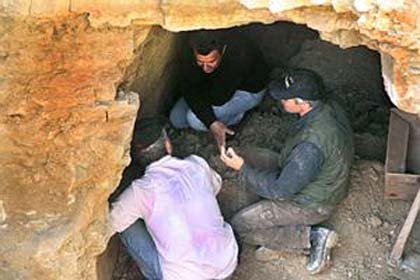
Workers from the Antiquities Department working in the ancient tomb in Kouklia village near the coastal town of Paphos, Cyprus, on Thursday, March 16, 2006. An extremely rare, 2,500 year old stone coffin with well preserved color illustrations from Homer's epics has been discovered in the western part of Cyprus. The white stone sarcophagus was accidentally discovered by construction workers last week in a tomb near the village of Kouklia. The artifact dated to 500 B.C., when Greek cultural influence was gaining a firm hold on the Mediterranean island of Cyprus.
Sunday, March 19, 2006
Did you know ...
... that “larnacaairport.com” directs you to a website that is promoting occupied Cyprus? The link above directs you to the website of the "Ministry of Economy and Tourism" of North Cyprus.
Thursday, March 16, 2006
"International Crisis Group"
From The Cyprus Weekly:
More...
Crisis Group report denounced as shockingly pro-Turkish
Turkey and TCs praised for Annan Plan acceptance
A REPORT by the "International Crisis Group" (ICG) on the Cyprus situation in Cyprus was denounced as completely biased, pro-Turkish and as such inconsequential and unacceptable by Government Spokesman George Lillikas and other Greek Cypriot personalities yesterday.
The report entitled `The Cyprus Stalemate: What Next?' which was presented in Nicosia on Wednesday, cites President Tassos Papadopoulos as the main obstacle to a Cyprus settlement.
Its main theme is that the controversial Annan Plan, which was overwhelmingly rejected by the Greek Cypriots in the 2004 referendum, "represents the only feasible basis for a reunification solution," and praises Turkey and the Turkish Cypriots for accepting it in a their separate referendum.
The 30-page report analyses the situation in a way that absolves Turkey completely of any blame for its continuing occupation of north Cyprus (something it studiously avoids mentioning) and its consequences.
No reference to UN resolutions
It also avoids any reference to the ethnic cleansing of the Greek Cypriot population of the north, the gross violations of the human rights of the displaced Greek Cypriot refugees, and to the judgements of the European Court of Human Rights.
These found Turkey guilty, repeatedly ordering it to allow the refugees to return and to regain their usurped properties This is something restricted by the Annan Plan which is so strongly backed by the IGC report.
IGC also avoids any reference to the numerous UN resolutions that demand the reunification of the island, the unconditional return of the refugees, the withdrawal of the Turkish occupation troops and the tens of thousands of mainland settlers introduced to the occupied north in violation of the Geneva Conventions. These resolutions brand the breakaway Turkish Cypriot state illegal and a vassal state of Turkey and urge the international community to have nothing to do with it. Despite this the IGC report's other main thrust is for and ending to the ``isolation'' of the breakaway Turkish Cypriot state as a reward for its acceptance of the Annan Plan.
It is as if this acceptance by itself automatically nullifies the judgements of the Rights Court and the UN resolutions, legitimising the breakaway state and all the other illegal consequences of the Turkish invasion and occupation. Indeed the report argues that ``the 2004 vote in the north for reunification has invalidated the political logic of isolation.''
In connection with the settlers the report says their influx continues and warns that this increases the risk of the Turkish Cypriots "becoming a minority in their own part of the island," taking it for granted that the north belongs to them and not to the people of Cyprus as a whole!
While pushing hard on the "isolation" issue the report avoids reference to the substantial financial gain of the economy of the north resulting from the income of the thousands of Turkish Cypriots crossing to work in the south, of the government pension payments to the north and free medical aid.
It also avoids explaining that the "isolation," where it exists, is brought on as much by the breakaway state itself which insists on being treated as an equal with the Cyprus government. This insistence prompted it to reject EU aid of 120m euros, insisting this should be paid to it direct and not through the Cyprus government!
Criticism of Papadopoulos
In its determination to blame President Papadopoulos, the report ignores his repeated statements that a Cyprus settlement must be firmly based on the relevant UN resolutions, respect for Human Rights, the judgements of the Rights Court, and, following the accession of Cyprus to the European Union, compliance with the EU aquis, or basic EU principles.
These fundamental demands are also ignored by the Annan Plan and this was one of the main reasons for its overwhelming rejection by the Greek Cypriots in the 2004 referendum.
It is for these reasons, among others, that the plan was accepted in the separate Turkish Cypriot referendum whose outcome was determined by the participation of the illegal Turkish mainland settlers who had every reason to vote `Yes,' since the plan legitimises their stay in the island.
The report states bluntly that "the most substantial blockage of such an agreement (based on the Annan Plan) is now the policy and attitude of the Greek Cypriot leadership and in particular of President Tassos Papadopoulos."
It charges that President Papadopoulos "does not seem to have any inclination, or coherent strategy on how, to get reunification back on track, and the prospects of achieving it look bleak."
The report rejects the conclusions of the Annan-Papadopoulos Paris meeting last month as inconsequential. It declares that this ended with "no indication of serious re-engagement by the Greek Cypriot side."
This contrasts glaringly with the view of the US Ambassador to Cyprus Ronald Schlicher who, during a visit to Limassol this week, described the outcome of the Paris meeting as a major breakthrough in the settlement efforts.
In its staunch support of the Annan Plan, the report quotes people backing it but avoids any parallel reference to the many prominent international critics, including eminent jurists, who maintain it is so flawed, and pro-Turkish, as to be unacceptable.
'We gave Cyprus to Turkey in form of the Annan Plan'
In this respect, it is worth recalling the blunt public admission by a senior United States State Department official, who summed up the situation by declaring in public that "we gave Cyprus to Turkey in the form of the Annan Plan."
Report excerpts and comments
THE report is too long to reproduce in full. Here are some of its key points, glaring inconsistencies and recommendations (with page reference):
1 - The report refers to Turkey's right to intervene militarily under the Treaty of Guarantee following the 1974 coup by the Greek junta. But it avoids clarifying that this right was strictly aimed at restoring the constitutional order, not to occupy the north, expel the Greek Cypriot population and eventually proclaim a breakaway state.
4 - Reference to ``143,000 Turkish Cypriots going to the polls'' in the 1974 referendum, without specifying that this figure included the illegal mainland settlers who had every reason to vote `Yes," and who outnumbered the native voters as claimed by Turkish Cypriots themselves.
7 - Saying that that "Claims that the Annan Plan violated EU law and the European Convention of Human Rights are overstated." This in effect admits that rights are violated, but sidelines the natural expectation that any violations must cease, and not be condoned.
7 - "Complaints about the Annan Plan's toleration of the continued presence of Turkish troops are overstated ... Complete demilitarisation of the island was unattainable in the context of the 1960 constitutional treaties, which were not in question in the 2004 referendum.'' It is strange that the report justifies the presence of the Turkish troops under the 1960 treaties, but ignored all the other provisions of the same treaties which are also ignored by the Annan Plan.
7 - The report argues that the Greek Cypriots should have voted yes in the referendum ``so that many refugees could return home, rather than `no' so that none could return.'' The `No' vote was precisely because the Annan Plan did not allow all the refugees to return, as demanded by UN resolutions and international law.
13 - In a remarkable piece of advice to the Greek Cypriots, the report says that "if they are worried about the Turkish Cypriots seeking recognition, they should call their presumed bluff and accept the Annan Plan."
20 - In an even more remarkable passage, the report makes a brief comment that unwittingly reveals the main obstacle to a settlement all these years. The comment says that following its accession to the EU Cyprus is using this to increase pressure on Turkey. But it then adds that "it is most improbable that any Turkey government now or in the future could afford to give up Cyprus for the sake of EU membership." This is clearly an admission that Turkey intends to maintain its hold on Cyprus no matter what.
Threat of secession is repeated
Taking this further, the report in effect warns that if the EU rejects Turkey's full membership, then "Turkey's incentives to seek accommodation with anyone in the EU, let alone the Cyprus government, would greatly diminish, and the likelihood of a push for TRNC secession would accordingly increase.''
21 - The threat of secession is also repeated in a reference to the likelihood of the rejection of an agreed solution in a second referendum. In such a case "the two communities could then be granted the option of separate self-determination by the international community."
28 - The report argues that following the accession of Cyprus to the EU, "the EU has become part and parcel of the conflict and cannot credibly undertake a mediating role: this will remain the responsibility of the UN." But the EU should assist in ``the economic development and European integration of northern Cyprus and contribute constructively to the much-abused `European solution' slogan on the island.'' It should also increase bilateral contacts with Turkish Cypriot politicians and maintain ``constant pressure on the Greek Cypriot government to moderate its intransigence.''
29 - The EU, the US and other states should open branch offices in the north.
Expanding on this, the report says one option that could be considered, "if international impatience with the Greek Cypriots became very strong," would be for the UN to decide that a Cyprus delegation would only be seated if it included representations from both communities.
Other intergovernmental institutions such as the Council of Europe "could follow suit." If Cyprus refused, the report says, this would "open the way for the separate international political representation of the Turkish Cypriots, with all that would imply."
More...
International Crisis Group
Report extremely biased
THE government and Greek Cypriots in general were rightly angered this week by the extremely biased, pro-Turkish report of the International Crisis Group entitled "Reflections on the Cyprus Stalemate: What Next?"
The government tried to play down the importance of the report, arguing that the IGC is a little-known group and that its biased report is of no consequence.
The wide distribution of the report, however, is clearly a major public relations coup for Turkey and the breakaway Turkish Cypriot state who are presented as the angels in the Cyprus imbroglio, while President Tassos Papadopoulos is demonised as the main obstacle to a settlement.
The nature of the report was summed up perfectly by Andreas Theophanous, the Director of the Research and development Centre of Intercollege. He described it as an attempt at historical revisionism similar to the attempt by certain people who argue the Nazi holocaust never happened, since the authors of the ICG report also claim Turkey committed no war crimes or human rights violations in Cyprus.
Anyone even faintly informed about the Cyprus problem realises, of course, how unfair and deliberately misleading the report by the allegedly independent ICG is and how baseless is its demonisation of President Papadopoulos.
The vast majority of people everywhere who are unaware of the intricacies of the Cyprus problem, or of the unpunished continuing war crimes and gross human rights violations committed by Turkey as a result of its continuing occupation of north Cyprus, will undoubtedly form an erroneous view of the Cyprus problem if they come across this report. This is all the more worrying since the ICG Board of Governors is a perfectly respectable, widely representative collection of 56 prominent international personalities, including former Prime Ministers and other senior politicians, diplomats and other VIPs from many countries.
One may well wonder whether any of these 56 governors are aware of the report or even if they have read, and agree with its twisted conclusions.
This is immaterial however; the sad reality is that this report has been published and may damage the just cause of Cyprus.
One would have expected that the Cyprus government would have wasted no time in arranging a press conference, or at least in issuing a statement, to demolish the gross inaccuracies and castigate the equally gross omissions and deliberate misrepresentations of the ICG report, allowing its presenters to remain officially unchallenged.
Viewpoint, Cyprus Weekly, March 2006
Sunday, March 12, 2006
Famagusta Video
I found the link to this video from David Koyzi's website. It is video footage taken last year of Famagusta including the ghost town of Varosha in the occupied North. A small bit of info on Famagusta: When Famagusta was conquered by the Ottoman Turks in 1571, the Cypriot inhabitants were expelled from the old walled city but did not leave the area and settled close by to the south. Varosh means suburb in Turkish, so Varosha refers to the suburb of Famagusta. Today, Famagusta can mean both, the old walled town of Famagusta and the ghost town of Varosha.
Friday, March 10, 2006
Obliterated ... Why?
With the flight of the Greek population, Turkey succeeded in her first target: the region ceased to live and breathe to the tune to which it had done for almost three millennia of its history. Here is a recent article from Chiesa (Italiana) that talks about Cyprus and the pillaging and destruction that occurred after the Turkish invasion. Article in its entirety:
Cyprus: Portrait of a Christianity Obliterated
In the northern part of the island, occupied by Turkey, the churches have become stables or mosques. The diary of a trip beyond the wall
by Sandro Magister
ROMA, March 9 2006 – The island of Cyprus was the first destination of the “special mission” that the Holy Spirit entrusted to Paul and Barnabas, according to what is written in the Acts of the Apostles, in chapter 13.
On the island they found a Roman governor, Sergius Paulus, “an intelligent man who wanted to hear the word of God and believed, deeply shaken by the teaching of the Lord.”
But if Paul and Barnabas were to return to Cyprus today, to the northern part of the island, they would find not the Romans as governors, but the Turks.
And instead of a Christianity being born, they would find a dying Christianity, with the churches and monasteries in ruin, or else transformed into stables, hotels, and mosques.
This is documented in a startling report from Luigi Geninazzi, who was sent to Cyprus by “Avvenire,” the newspaper of the Italian bishops’ conference.
Cyprus became part of the European Union on May 1, 2004. But this was true only for the southern part of the island, which is Greek and Christian.
The northern part was occupied by Turkey in 1974, with 40,000 soldiers. The Turkish occupation caused death, destruction, and a forced relocation of populations. About 200,000 Greek Cypriots of the Christian Orthodox faith who lived in the north of the island fled to the south. And likewise, the Turkish Cypriots of the south, Muslims, moved to the north.
In 1983 Turkey consolidated the occupation by creating a Turkish Republic of Northern Cyprus, which is internationally recognized only by the government of Ankara: 180,000 persons live there, 100,000 of whom are colonists originally from Anatolia.
A wall guarded by the blue helmets of the United Nations divides the two parts of the island and cuts through the capital, Nicosia. In April of 2004, the UN placed before a referendum a plan of confederation between the two states, but this was rejected by the Greek Cypriots of the south, who are four times as numerous as the Turkish Cypriots of the north.
The Islamization of the north of the island has been concretized in the destruction of all that was Christian. Yannis Eliades, director of the Byzantine Museum of Nicosia, calculates that 25,000 icons have disappeared from the churches in the zone occupied by the Turks.
For a Turkey that aspires to enter the European Union, its actions in the north of Cyprus give a terrible impression of itself.
And what it has done in destroying the Christian presence begun by Paul and Barnabas is described in the report that follows, published in “Avvenire” on Sunday, February 26:
"They did not even spare the stone altar..."
by Luigi Geninazzi
Europe ends here, in the most beautiful island of the Mediterranean, torn by a wall that splits it in two. Europe ends abruptly along a barrier of barbed wire, cement, and military turrets that splits Cyprus along its entire width and divides Nicosia, a capital wounded in its ancient heart.
For the UN, which guards over it with its blue helmets, it is the “green line.” But here the people continue to call it the “Attila line,” from the name that the Turks gave to the invasion.
The scourge has left its marks. It has struck Cyprus, the site of the most ancient Christian community on European soil, in its artistic, cultural, and religious treasury: stupendous Byzantine and Romanesque churches, imposing monasteries, mosaics and frescoes of inestimable value. It is a heritage that in the northern part of the island, under Turkish occupation, has been sacked, violated, and destroyed.
To realize this it is enough to cross the “Attila line” at the checkpoint of Nicosia, and there you are in the so-called Turkish Republic of Northern Cyprus, which greets the visitor with a large banner on which is written a topsy-turvy welcome: “How happy I am to be a Turk!” (a famous phrase of Kemal Ataturk). The nationalist pride of the descendents of the Ottoman empire has also modified the natural countryside, carving the crescent moon and the red star on the side of the Pentadattilos mountains, which dominate the wide plains.
The Turkish flag billows on the façade of the church of Agia Paraskevi, in the once Greek Orthodox village of Angastina. A sign says that work is underway to transform it into a mosque. The bell tower, which no longer bears a cross, is a strange minaret with the loudspeaker of the muezzin fixed upon an archway.
Christodoulos, the young archeologist accompanying me, is visibly shaken: “I was baptized here,” he says in a voice hoarse with emotion. He is one of the 200,000 Greek Cypriot refugees who, thirty years ago, lived in the north of the island and were chased out of their homes.
Christodoulos kneels on the spot where he was once baptized and lights a candle. The Turkish construction workers, squatting in front of the apse for their lunch break, look at him curiously: “Every time I come back to this area, it’s always worse,” he sighs.
We stop at Trachoni, where a jewel of the Renaissance once stood, the church of the Panagia, Our Lady. Now only the walls are left; the interior bears the signs of vandalism that has not spared even the stone altar, the pieces of which have ended up in a hole dug recently to search for who knows what treasure.
Ours is a sad pilgrimage that at every stop adds to one’s outrage and disbelief, a via dolorosa that retraces the places of Christian memory at risk of disappearing. At the village of Peristerona, on the road to Famagosta, the medieval monastery of Saint Anastasia (see photo) is being used as a stable, with the cows chewing their cud amid what remains of the ancient cells. The tombs of the cemetery have been profaned, and the gravestones broken.
We leave the countryside behind and go to the coast. Here many of the churches have been turned into restaurants, bars, and nightclubs, for the enjoyment of the tourists. At the top of the rock of Lapethos, which juts out over the sea, the church and convent of Agia Anastasia have become a sumptuous hotel with a swimming pool dug into the cloister, and a casino under the bell tower.
Almost the entire artistic patrimony of the Orthodox Church in the territory occupied by the Turks – 520 buildings between churches, chapels, and monasteries – has been sacked, demolished, or disfigured. Only three churches and one monastery, the monastery of Saint Barnabas, which has been turned into a museum, are in a more or less dignified state.
“The ruin is before our eyes, but the European Union prefers to look the other way,” the Cypriot foreign minister, George Iacovou, bitterly tells us. “The only hope is that, in the course of negotiations for Turkey’s adhesion to the EU, someone might pull out the dossier of shame.”
The Byzantine Academy of Nicosia has gathered detailed and meticulous documentation on the occupied churches in Cyprus. And for two years an attempt has been made at religious dialogue, with the support of the Orthodox bishop Nikiforos of the historic monastery of Kykko: “We have met with the Muslim leaders headed by Lefka, and I told them that respect for our places of worship is the basis for cooperation.” Nikiforos is moderately optimistic: “I encountered a lot of understanding. Errors have been made on both sides; we must overcome the divisions of the past and walk together.”
But the last word belongs to the politicians. Huseyn Ozel, a government spokesman for the so-called Turkish Republic of Northern Cyprus, displays great cordiality with the foreign journalist. The destroyed and sacked churches? “There was a war, and bad things happened on both sides,” he explains.
I point out to him that most of the mosques in Greek Cypriot territory have been restored, while his government has authorized the transformation of churches into restaurants and hotels, an insult to the sentiment of believers. “They did this to keep the buildings from falling into ruin, and anyway, these are decisions made by the preceding government, which I do not share,” Ozel counters.
I insist: what do you have to say about the churches that, still today, are being turned into mosques? The Turkish Cypriot functionary spreads his arms wide: “It is an Ottoman custom...”
It as a tradition that, unfortunately, continues. An unsettling calling card for a Turkey that aspires to enter the European club.
__________
The Greek Orthodox bishop: "Europe, intervene!"
An interview with Chrisostomos Englistriota
In Cyprus, the head of the Church has always been an ethnarch, too, a leader of the people. This directly political role was exercised by the famous archbishop Makarios, the charismatic leader of the rebellion against the English domination during the 1950’s, and the first president of the independent republic of Cyprus.
“Our Church doesn’t practice politics anymore, but its authority has not diminished,” recalls the bishop of Paphos, Chrisostomos Englistriota. Since His Beatitude Chrisostomos I was struck by a grave illness, the bishop of Paphos has carried out his functions as leader of the Holy Synod of the Orthodox Church on the island.
Q: Your Excellency, Cyprus remains divided. Can the Greek Orthodox Church foster dialogue between the parties?
A: “It is a situation that saddens us deeply, the result of a completely illegal military occupation. A true dialogue is impossible, because the Turkish Cypriots do not enjoy any autonomy, the last word belongs to the government of Ankara.”
Q: Are there contacts among the religious exponents?
A: “Some of our bishops have met with the leaders of the Turkish Cypriot Islamic community. It’s important to us to have good relations with them, but then when it comes time to discuss concrete matters, like the problem of the sacking and profanation of our churches, they don’t know what to say, they refer everything to the political authorities.”
Q: Have you tried to raise the question in international circles?
A: “Yes, of course. We have repeatedly turned to the European Union to ask for their intervention. The last time was in the autumn of 2004, after Cyprus entered the EU.”
Q: The results?
A: “Nothing so far. My personal conviction is that the European governments should exert pressure on Turkey, above all in this phase of the opening of negotiations for the entry of Ankara into the Union. But they don’t want to take advantage of this opportunity. And so the more time passes, the more our sacred places in the northern part of Cyprus are falling into ruin. The Turks want to destroy every trace of Hellenism and of Christianity. Only strong international pressure can stop them.”
Interesting reading, right? Just search the word "destruction" on this site to get an idea of the ongoing cultural obliteration.
So, a great article from Chiesa. Truly amazing and i say this because it is very rare to read such an accurate depiction of Turkey's occupation from the western press as to not upset a key NATO ally. Obviously there are some exceptions. Below are some foreign publications and what they had to say in the past about this so called special "peace operation".
The Times
"It is important to distinguish between random damage that might have been caused by drunks after a night out, and the demolition of crosses, tombstones and heavy marble slabs which weigh several hundredwieht and would need men with sledgehammers to destroy them. We found nothing to fit the first category. In fact, at Dhavlos, on the north coast, now occupied by mainland Turks, even the graveyard wall was partly demolished. Not a single tombstone remained standing...
..the process of obliterating everything Greek has been carried out methodically. The churches and graveyards have suffered severely."
"The Times", 5.27.1976
"The little treasure house of Antiphonitis Monastery, in the mountains north of Lefkoniko, had sustained the most comprehensive looting and damage....the 11th, 12th, and 15th century icons..all had vanished or had been destroyed. The nineteenth and twentieth century icons were smashed, the furniture broken. In the corner were bags of cement and the remains of a fire. Furniture had been lugged outside onto the grass, and the whole place was a strewn with bottles and filth. Somebody was clearly proud of this work, for the wrecked iconostasis the date was chalked March 6, 1975."
"The Times", 5.27.1976
The report (August 9)from the Cyprus Director of Antiquities on the recent looting or desecration of the mosaics in the church of Panayia Kanakaria in the Turkish occupied north of Cyprus has reopened the debate on the fate of churches, monasteries and mosques on that unhappy island.
As a journalist I have travelled widely and freely on both sides of the partition line. In Turkish Cyprus there was large scale damage to churches in the immediate aftermath of the 1974 intervention. That was perhaps understandahle. More recently, historic churches have been seized, stripped and whitewashed and converted into mosques. One example is on the fringes of Nicosia, another outside Famagusta. Others have been desecrated.
Less than a year ago, travelling in the company of Mr. Mustapha Adiloglou, press official in London of the Turkish Federated State of Cyprus we came across a desecrated church in the centre of a busy village between Famagusta and Nicosia. Fresh excrement and urine lay on the smashed altar and the floor. The church Bible had been used as toilet paper and the wall paintings gashed and disfigured. The icons had vanished. From the state of the place it was clear that this was not a single act of violation. The place obviously had been a public convenience for months.
In fairness one should add that some churches (particularly tourist conscious Kyrenia) have been restored by the rurkish authorities and are either open for prayer or tourism or securely locked.
"The Times", 19.8.80
Yenidyzen
"The Turkish Cypriot Arts Society leader, Ali Atakan, in a statement issued on May 20 revealed yet more antique smuggling. According to this revelation, a valuable Byzantine mosaic has been stolen from a Byzantine Church in the village of Lythrangomi. There are two inter-connected churches in the village and the mosaic was stolen from the apse of the older church which dates back to the 8th century..."
Turkish Cypriot "Yenidyzen", 6.1.1982
"You will see chambers cut out of the rocks, lighthouses, the remains of baths, layouts and the military camps set up on the ruins both before and after 1974... Today Lambousa is a military zone closed to tourists. Here are many important churches and the mythological Akhiropietos Monastery. Now you cannot see it because it is being used as a military warehouse. The icons stolen from Lambousa were retrieved while being smuggled out of Ankara airport."
Le Monde
"The antiques are illegaly exported from the northern part of the island, especially rich in archaeological sites'
"Le Monde", 12.27.1978
Bozkurt
"The Cyprus Arts Society in the occupied areas issued a press release saying that the antique smuggling in the occupied areas has reached enourmous dimensions and that measures should be taken to protect the destruction of the antiques."
Turkish Cypriot "Bozkurt", 7.4.1982
The Guardian
"We visited 26 former Greek villages. We found not a single undesecrated cemetery..."
"...The vandalism and desecration are so methodical and so widespread that they amount to institutionalised obliteration of everything sacred to a Greek ... In some instances, an entire graveyard of 50 or more tombs had been reduced to pieces or rubble no larger than a matchbox...we found the chapel of Ayios Demetrios at Ardhana empty but for the remains of the altar plinth, and that was fouled with human excrement... At Syngrasis ... the broken crucifix was drenched in urine.. At Lefkoniko ...the interior of Gaidhouras church... was overlooked by an armless Christ on a smashed crucifix... Tombs gaped open wherever we went...crosses bearing the pictures of those burried beneath ... had been flattened and destroyed.
"The Guardian", 'The Rape of northern Cyprus', 5.6.1976
Ortam
"The trial of the director sic of Kyrenia Museum, Mehmet Rasih, has ended with the case being referred to the "criminal court". The trial is connected with the 3 chests of antiques discovered in Turkey on their way to Germany, on 16.3.1981... The number of the missing icons or substituted icons were 225 ...later it was found that large icons had been sawn down to smaller sizes and thus entered in the books."
Turkish Cypriot "Ortam", 5.6.1982
Bozkurt
"Two icons estimated to cost arounf TL 1 million were stolen from Kyrenia "Court". The icons stolen from the village church of Karmi 5 months ago were found in the Famagusta district and 4 persons were arrested in connection with the incident. The icons were locked away in Kyrenia "Court-House" to be stolen again."
Turkish Cypriot "Bozkurt", 3.9.1979
The Times
"Confidential United Nations military documents, circulated to officers in the United Nations peace - keeping force in Cyprus, disclose that looting is being systematically carried out on a massive scale by the Turkish and Turkish Cypriot authorities in the north of the island"
"The Times", 12.13.1976
"...historic churches have been seized, stripped and whitewashed and converted into mosques ... Others have been desecrated. ... we came across a desecrated church in the center of a busy village between Famagusta and Nicosia. Fresh excrement and urine lay on the smashed altar and the floor. The church Bible had been used as toilet paper and the wall paintings gashed and disfigured. The icons had vanished. From the state of the place it was clear that this was not a single act of violation. The place obviously had been a public convenience for months. ... On the Greek side all the mosques I have seen are securely locked and protected."
"The Times", 8.19.80
The Sunday Times
"Scotland Yard and Customs Officials are uncovering a highly organized smuggling network behind the trail of antiques looted in Cyprus"
"The Sunday Times", 4.25.1976
OPEN GRAVES, BROKEN CROSSES...
The Times
The above testimony, by a British journalist, member of the crew of a British TV network which visited the occupied part of Cyprus, proved that the places of rest of the dead became targets of the most intense destruction mania. According to this and other testimonies, the crosses on graves were cut away and broken to pieces. Tombstones were also overturned and crushed to bits, while the invaders violated the graves.
"We managed to check 26 villages in all. Some other villages, such as Marathovouno and Pyrga, were sealed by the Army and access to the church itself was not possible. Since graveyards are usually some way out of the village, these were checkable and, in every instance, we found deliberate and usually comprehensive damage. In no village we visited was the graveyard intact"
"The Times", 5.27.1976
The Guardian
"We visited 26 former Greek villages. We found not a single undesecrated cemetery..."
"The Guardian", 5.6.1976
"The next village had been -until the events of 1974- Greek. Now it is deserted but for Turkish refugee squatters. There are two churches in the village. One has been stripped and converted into a mosque. A few Turkish Cypriots kneel, praying, inside it. The other church has been vandalised. The exterior walls are covered with illegible graffiti. Inside, the destruction is complete. The body of the church is bare of pews or chairs. The alter screen, composed of six-inch timbers, has been wrenched out, the icons have been looted. Among the filth on the floor lies the torn remains of an antique bible. ...The altar ... has been smashed. On the remains of the altar are broken bottles, excrement, and what smells like urine. When asked about the desecrated Greek church and the massacre villages, Rauf Denktash, "president of Turkish Cypriots"...ads that it all shows that Greeks and Turks can no longer live side by side on the island".
"The Guardian", 11.30.1979
OLAY
"Illegal digs are being made in all districts. For example, in Kyrenia, in Ayios Epiktitos, in Nicosia, and in the hills beyond Krini. But, Famagusta is the most suitable for illegal digs. Illegal digs virtually cover the whole district. In this district the first settlements were established and since ancient times they had maintained their historical importance.
Illegal digs in the Karpass start from the cliff in the east, from the small islets in the sea, and from the caves of Galinoporni, and extend to the north-west of the Karpass, to Eptakomi, Ovogoros, Galatia and Ardhana".
Turkish Cypriot, "Olay", 1 7.5. 1982.
The Observer
"Vandals have desecrated scores of British graves in Turkish occupied northern Cyprus, some of them dedicated to First World War soldiers ... The wrecking of British gravestones pales beside the destruction in Christian Greek Orthodox cemeteries ... Every cross has been destroyed and the tombs gape open to the elements, the lizards and the robbers, spurred on by the superstition that the Greeks have valuables buried with them"
"The Observer", 3.29.87
OLAY, April 1982.
"Haven't you heard that the 2000 year old Christian church in Cyprus, St Barnabas' Church, has been robbed? Haven't you heard that 35 icons were stolen, that 11 of them were found in Kythrea, that 11 were retrieved at Ankara airport while being smuggled out, and that the rest are lost? Haven't you heard what's happening in Varosha (Famagusta)? Haven't you heard that figurines belonging to the Catholic period and kept in the Archaelogical Museum have been stolen and smuggled to London? What about the icons in the other churches; the mosaics, the private collections, the illegal digs? Why have they stopped the digs started before 1974 at the city of Gastria, which belongs to the geometric age? Do you know what happened since then? The government has issued permits to certain businessmen from Turkey to set up a gypsum factory there. The tombs were destroyed and plundered."
Mehmet Yasin, "Perishing Cyprus" in the Turkish Cypriot Review "Olay", April 1982.
Monday, March 06, 2006
A Must Read ...
 An International Relations Debacle
The UN Secretary-General's Mission of Good Offices in Cyprus 1999-2004
Claire Palley
This book by Claire Palley, is a must read for those interested in the Cyprus problem and how the final version of the Annan plan came to be. The roles played by major powers exerting strong influence on the UN are emphasized in this book. Its amazing how the Cypriot voters were given only three weeks to consider a 9,000 or so page plan. A plan that practically met all Turkish demands, crafted to decriminalize Turkey's policy on Cyprus and to pave the way for a smooth accession of Turkey into the EU. On 24 April 2004, democracy had spoken in Cyprus as the Greek Cypriots used their democratic right at the ballot box, rejecting what they've been told in no uncertain terms to accept. The book (pp. 395, h/b,) sells for CY£23.65
Saturday, March 04, 2006
Cypriot Cancer Activists
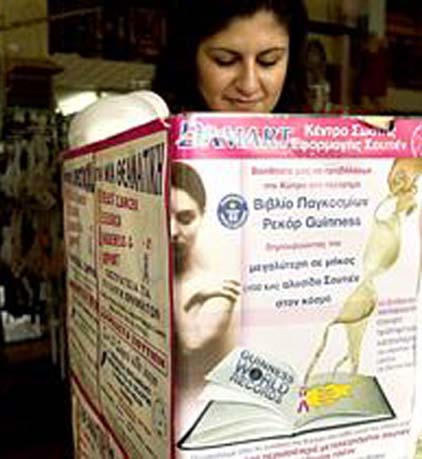
A shopkeeper counts bras in a donation box in a shop in Nicosia, Cyprus, Friday, March 3, 2006. Cypriot cancer activists said they hope to create the world's longest chain of bras next month to raise money and awareness for breast cancer treatment. A sign on the box urges women to donate bras to create the longest chain in the world for entry in the Guinness Book of Records. Cypriot Cancer Patients Support Group: www.cancerpatientssupport.com
Wednesday, March 01, 2006
Press Conference: Papadopoulos Annan
Following their meeting today in Paris, President Papadopoulos and the Secretary-General Kofi Annan held a joint press conference.
Question: What will be the role of the EU during this process?
Secretary-General: As you know, during the exercise of my good offices over the years, we have cooperated very effectively with the European Union and we intended to cooperate with them. In some situations they have provided experts and they have provided other assistance. In some cases, [we] exchanged ideas on some of the technical issues and process, of the exercise of my good offices and I would expect [them] to work with me in that spirit. Besides, they have a direct interest in the settlement of this issue.
President Papadopoulos: I agree with the Secretary-General. Our position is very clear. We want the European Union to have a more active role in the process and I have assurances that they are prepared to do that. The Cyprus problem remains under the aegis of the United Nations and the Secretary-General.
Secretary-General: As I said, the EU has always been supportive and I expect them to continue to be supportive. There is no problem about it.
Question: Mr. Secretary-General, what to you think of the recent Turkish proposals and, second, are you planning to invite Mr. Talat for the same meeting and are you going to appoint a new Cyprus envoy?
Secretary-General: First of all, we just wished Mr. Talat well. Be patient and be merciful. Let him get well first. Once he’s back on his feet, it is not excluded that we will have an opportunity to meet in New York some time in the future. As I said, we took stock of the negotiations, of the process of settlement of the Cyprus issue and we also touched on the Turkish initiative. We are going to take a look at a whole series of actions and Turkey does admit that it has an obligation, under the EU requirement, to undertake certain steps which it will take. But, of course, there were other measures proposed in their plan of action and, today, we looked at a whole series of other activities that the two sides can undertake, am I talking of the Turkish Cypriot side and [the Greek Cypriot side] and we will see what proposals we bring together for the parties to act on.
On the question of appointment of an envoy, yes, in the application of my Good Offices I usually do have an envoy and, at the right time, I will appoint an envoy, but that does not mean that we are not doing any work on the question. First of all, I have a very competent Special Representative on the ground, Mr. Michael Mψller, whom I hope most of you have met, and he’s going to work with the parties on certain steps and certain actions that they will need to take. We will be back-stopping and preparing for these things in New York with my Under-Secretary-General, Ibrahim Gambari and his staff, and when the time is ripe I will appoint an envoy.
Question: Did you also discuss the issue of the missing people?
Secretary-General: Yes, we are just about to appoint a third member of the [Missing Persons] Committee and they will begin their work very soon and I do expect the two communities to work very expeditiously on this and move forward. There will be a full-time member [of the Committee] on the island.
Question: Do you consider this meeting with President Papadopoulos a step forward in the process of the Cyprus forward?
Secretary-General: In negotiations, sometimes people say that as long as you are talking you are making progress. But what I have indicated, what I would want to see, is a much narrower gap between our words and our actions. In the next couple of months, we are going to do whatever we can to do narrow that gap as we move ahead with the process.
Question: Mr. Secretary-General did you get in this meeting some new ideas from Pres. Papadopoulos [inaudible] and that the process will start soon. Is there enough time to do it before the end of your term?
Secretary-General: Let me say that, yes, there were quite a few proposals that were put on the table this afternoon, which we are going to analyze carefully and see how we can put them into action, after consulting the other side, working together and come up with a programme of action which we can begin to work on the ground. Obviously, when you are handling these sorts of negotiations, where there is a will among the parties things can move very fast. When the will is not there, it can take you a long time. Let’s start with the initiatives I just said that we discussed today and begin to take concrete steps and see how things can be accelerated. And I hope that it will help bridge what I refer to as the gap between words and actions.
Question: It is a symbolic question. We see you for the first time standing outside of the UN in front of the flag of the Republic of Cyprus. Is this some kind of measures that we have to keep in mind?
Secretary-General: Let me assure you that I will not want his job. I am looking forward at the end of the year, of having a balance between action and reflection and taking some rest. So, do not worry, I am not heading to Nicosia to take on another job.
President Papadopoulos: I will send my best wishes to Mr. Talat for a quick recovery. I wish him a speedy recovery. [inaudible]
Question: Mr. Annan how optimistic are you?
Secretary-General: I am always optimistic.
Tuesday, February 28, 2006
Papadopoulos Annan Meeting
From The CNA:
UN Secretary General Kofi Annan noted today with satisfaction that the leaders of both communities in Cyprus have agreed that bicommunal discussions on a series of issues, agreement on which is needed for the benefit of all Cypriots, will be undertaken at the technical level.
A joint statement issued after an hour-long meeting in Paris between Annan and Cypriot President Tassos Papadopoulos, read out to the press in English by Annan`s Spokesman Stephan Dujarric, says that Annan and President Papadopoulos agreed to continue their ongoing dialogue with the expressed aim at accelerating the search for a comprehensive, fair and mutually acceptable solution to the Cyprus problem.
According to the statement, ``UN Secretary General Mr. Kofi Annan and President Mr. Tassos Papadopoulos met in Paris today to review the situation in Cyprus and examined modalities for moving forward on the process leading to the reunification of the island.``
``They agreed, as they have in the past, that the resumption of the negotiating process within the framework of the Secretary General`s good offices must be timely and based on careful preparation,`` Dujarric said.
He added that ``to that end the Secretary General was pleased to note that the leaders of both communities have agreed that bicommunal discussions on a series of issues, agreement on which is needed for the benefit of all Cypriots, will be undertaken at the technical level.``
``The Secretary General and President Papadopoulos expressed their common hope that these discussions would help restore trust between the two communities as well as prepare the way for the earliest full resumption of the negotiating process,`` he said.
Dujarric added that ``the Secretary General noted that he had received assurances from the leader of the Turkish Cypriot community Mr. Talat that he shared the same aspirations.``
``The Secretary General and Mr. Papadopoulos also agreed that it would be beneficial for all concerned and would greatly improve the atmosphere for further talks if progress could be achieved on further disengagement of forces and demilitarisation of the island, on the complete de-mining of Cyprus and on the issue of Famagusta,`` he said.
He pointed out that ``they took note of the recent decision by the European Union to release the much awaited funds for the benefit of the Turkish Cypriot community.``
``In this context they expressed their warm wishes for the full and speedy recovery of Mr. Talat,`` he added.
Concluding the statement, Dujarric said ``the Secretary General and President Papadopoulos agreed to continue their ongoing dialogue with the expressed aim at accelerating the search for a comprehensive, fair and mutually acceptable solution to the Cyprus problem.``
Following the statement, President Papadopoulos and Annan replied to questions.
Monday, February 27, 2006
Media Two Facedness
The European Union has agreed to unblock aid worth 139 million euros to the Turkish Cypriots, ending a two year dispute. This agreement could have been reached last year during Britain’s EU presidency but certain EU members insisted on linking the financial assistance with direct trade. The RoC government disagreed with this claiming that direct trade constitutes de facto recognition.
Lets recall how the press reacted back then when there was no agreement ... The money has been stuck in Brussels' coffers ever since, because the (Greek Cypriot) Republic of Cyprus, an EU member state since May 2004, has blocked the release of the funds. A statement like this or something similar was common when one read about this particular issue. Then of course followed by how the Greek Cypriots voted NO (oxi) to the Annan plan. Strong commentaries followed ... The audacity of the Greek Cypriots who make up only 700,000 people, do they not realize the Turkish Cypriots need these funds, how ohh how can they be punished when they voted YES to the Annan plan. SHAME! Fool me once, shame on you, fool me twice, shame on me!
Most of these articles that discuss the Cyprus issue will say, but Ankara says this and Ankara says that but never state what Nicosia’s view is on a given matter.
We don’t need to know what Ankara says, we only need to know the facts. Around the time when a few EU member States were pushing for linkage between financial assistance with direct trade, the news wires picked up a story on “balls to embargoes (their website),” a story about Turkish Cypriot Football players stripping off clothing in protest of the embargo. The organizer was quoted in the press as saying that the campaign is about human rights and not politics. Yes, the very same embargo that has helped spawn luxury villas and yachts dotted all over the North of the island. What am I going on about? It seems the Turks have already rejected the EU deal and only a handful of news agencies are reporting it. That's right, direct trade was not linked to the aid.
Does it meet their maximalist demands, it does not. Never the less, this is a compromise deal that is a benefit to the Turkish Cypriots. The money will fund projects to improve infrastructure and the economy in the North, is this not considered a benefit? The rejection also tells us that any possible future agreement on the Cypriot issue that does not contain the maximalist demands of the Turks and the authorities in the North, would be rejected outright. Here is an example of a press article being receptive to Turkish arguments. The Cyprus spin stops on this site ... Financial Times, step to the front line:
Is it controversial because the EU agreed to it or because the Turks find it unacceptable? I did not bother to read the rest of the article.
Lets recall how the press reacted back then when there was no agreement ... The money has been stuck in Brussels' coffers ever since, because the (Greek Cypriot) Republic of Cyprus, an EU member state since May 2004, has blocked the release of the funds. A statement like this or something similar was common when one read about this particular issue. Then of course followed by how the Greek Cypriots voted NO (oxi) to the Annan plan. Strong commentaries followed ... The audacity of the Greek Cypriots who make up only 700,000 people, do they not realize the Turkish Cypriots need these funds, how ohh how can they be punished when they voted YES to the Annan plan. SHAME! Fool me once, shame on you, fool me twice, shame on me!
Most of these articles that discuss the Cyprus issue will say, but Ankara says this and Ankara says that but never state what Nicosia’s view is on a given matter.
We don’t need to know what Ankara says, we only need to know the facts. Around the time when a few EU member States were pushing for linkage between financial assistance with direct trade, the news wires picked up a story on “balls to embargoes (their website),” a story about Turkish Cypriot Football players stripping off clothing in protest of the embargo. The organizer was quoted in the press as saying that the campaign is about human rights and not politics. Yes, the very same embargo that has helped spawn luxury villas and yachts dotted all over the North of the island. What am I going on about? It seems the Turks have already rejected the EU deal and only a handful of news agencies are reporting it. That's right, direct trade was not linked to the aid.
Does it meet their maximalist demands, it does not. Never the less, this is a compromise deal that is a benefit to the Turkish Cypriots. The money will fund projects to improve infrastructure and the economy in the North, is this not considered a benefit? The rejection also tells us that any possible future agreement on the Cypriot issue that does not contain the maximalist demands of the Turks and the authorities in the North, would be rejected outright. Here is an example of a press article being receptive to Turkish arguments. The Cyprus spin stops on this site ... Financial Times, step to the front line:
Turkey upset by EU deal on N Cyprus
By Daniel Dombey in Brussels and Vincent Boland in Ankara
Published: February 26 2006 18:49 | Last updated: February 26 2006 18:49
The European Union has agreed a controversial aid package for the Turkish Cypriot community in northern Cyprus, in a decision that has upset Turkey and threatens to complicate further Ankara’s negotiations to join the EU.
Is it controversial because the EU agreed to it or because the Turks find it unacceptable? I did not bother to read the rest of the article.
Saturday, February 25, 2006

Categories
| Aid/Cooperation | Annan Plan | Archaeology | Books | Cypriot Elections | Deep State | Direct Trade | ECHR | ECJ | Embargoed | Energy | EU-Turkey | Eupro | European Politics | Famagusta | Film Festival | Guarantor Powers | Haji Mike | Hypocrisy | Kyrenia | Ledra | Limnitis | Milestone | Morphou | News In Greek | Occupied Cyprus Adverts | Peace Initiatives | Photos | Polls | Settlers | Special Reports | Support | Title Deeds | U.S.-Turkey | Varosha | Videos | Viewpoint | Violations | War Crime | Warped Media |


| Aid/Cooperation | Annan Plan | Archaeology | Books | Cypriot Elections | Deep State | Direct Trade | ECHR | ECJ | Embargoed | Energy | EU-Turkey | Eupro | European Politics | Famagusta | Film Festival | Guarantor Powers | Haji Mike | Hypocrisy | Kyrenia | Ledra | Limnitis | Milestone | Morphou | News In Greek | Occupied Cyprus Adverts | Peace Initiatives | Photos | Polls | Settlers | Special Reports | Support | Title Deeds | U.S.-Turkey | Varosha | Videos | Viewpoint | Violations | War Crime | Warped Media |
Friday, February 24, 2006
Pardon My French!
Turkey yesterday refused to allow a Cyprus flagged ship to enter the Turkish port of Mersin. The government of RoC says the denial of permission to dock was a violation of the customs union agreement. Please read below for more details and to see what the Prime Minister of Turkey had to say about this matter.
Erdogan insult as Turkey turns Cyprus ship away
By Philippos Stylianou
A CONTAINER ship flying the Cypriot flag that sought to unload its cargo of textiles at the southern Turkish port of Mersin, was turned away, raising a storm in the already-troubled waters between Cyprus, Turkey and the EU.
Following protests by the Cyprus Government, EU Enlargement Commissioner Olli Rehn said yesterday that a European Parliament enlargement team stationed in Ankara had raised the issue with the Turkish authorities.
Rehn stressed that Turkey should honour the commitments it had undertaken in the framework of its association agreement and open its ports to Cyprus ships.
The incident came just as the Austrian Chancellor Wolfgang Schussel, holding the EU presidency, had called on Ankara after talks with visiting Cyprus President Papadopoulos, to enforce the EU accession protocol by opening its ports and airports to the Republic of Cyprus.
No attention
Turkish Prime Minister Tayyip Erdogan rudely rejected Schussel’s statements, saying that Turkey did not pay any attention to those who had threatened its EU perspective.
"Pardon the language, but to them we say up yours," Erdogan said addressing a meeting of businessman at the sea resort of Kusandasi.
In Nicosia, acting Government Spokesman Michalis Pashiardis referring to Ankara’s refusal to allow the docking of the Cypriot vessel said that "Turkey cannot dock in the port of the European Union with the high-handedness and the mentality of a pirate."
Immediately after the Mersin incident became known Government Spokesman Giorgos Lillikas said the Government was taking due action towards the Austrian EU Presidency, as well as to the European Commission.
Violation
"This act by Ankara constitutes a serious violation, inter alia, of the Customs Union Agreement, which exists between Turkey and the EU," Lillikas said, and added:
"With its stance, Turkey has proved yet once more that it refuses to harmonise itself with the acquis communautaire and is not convincing in its commitment to proceed in its EU course, exhibiting respect for its obligations."
The Cypriot container ship Able F arrived outside the port of Mersin from Italy early on Wednesday morning and remained about 3km offshore inside Turkish territorial waters waiting for its agent to make docking and unloading arrangements.
The port authorities automatically refused entry to the ship and alerted the Shipping Department, which in turn told the Turkish Foreign Ministry about it.
The Cypriot vessel was asked to leave Turkish territorial waters but, according to some reports, the ship authorities insisted on being given the grounds for being turned away in writing.
They met with the refusal of the Turkish authorities and the ship left Turkish waters under the wary eye of patrol boats after it had stayed there for about 15 hours.
Violated
According to an AP report, the Turkish Foreign Ministry in a statement alleged the Cypriot vessel had violated standard practice of port approaching presenting a "fait accompli."
Commenting on Turkey’s action, the spokesman of the Greek Foreign Ministry in Athens, Giorgos Koumoutsakos, said it was not helpful.
"Turkeys’ course towards the European Union and the progress of its accession process are judged in accordance with the degree of its response to specific conditions and prerequisites, which mainly refer to a series of agreed EU documents. It is obvious that today’s action by Turkey does not help; far from it," Koumoutsakos stressed.
The Turkish press gave wide coverage to the incident, mostly presenting it as an attempt by Cyprus to force open the question of Turkey lifting its embargo on Cypriot airplanes and vessels.
In his statements to the press, Pashiardis rejected Turkish allegations that the Cyprus Government knew of the intention of Able F to dock at Mersin.
Obliged
EU Commissioner Olli Rehn said that the Foreign Affairs Committee of the European Parliament would monitor very closely Turkey’s compliance with its EU obligations.
He also warned Turkey that in October the Committee would carry out a general evaluation of the situation, in order to verify Turkey’s compliance with all its commitments.
Rehn’s spokesperson, Krisztina Nagy, noted that according to the EU-Turkey Association Agreement that incorporated the customs union, Turkey was obliged to allow the free movement of goods for all EU member states.
"Shipping restrictions prevent those concerned to choose the most economical means of transport, resulting in obstacles being placed in the free movement of goods and commerce in general," she said.
The Able F’s textile cargo was being delivered to Turkish businessmen and the ship had an agent at the port of Mersin.
The Cyprus Shipowners’ Union yesterday condemned the action by the Turkish authorities and expressed support for the measures taken by the Cyprus Government.
They added that, in addition, they would ask for the help of the European Shipowners Union in making Turkey honour its protocol signature.
Cyprus Weekly, February 2006
A little more of this ...

A photo of Cypriot Health Minister Andreas Gavrielides (L) and Turkey's Health Minister Recep Akdag, pictured together at the beginning of an informal meeting about the "Impact of Avian Influenza on Public Health in Europe" in Vienna February 24, 2006.
Thursday, February 23, 2006
Stratfor Faux Pas
Stratfor has an article on Turkey's Accession to the European Union. Both, its Summary and Analysis are inaccurate. The Summary part of the article begins by stating that “Turkey should recognize Cyprus by the end of 2006, Austrian Chancellor Wolfgang Schuessel said Feb. 21.” What Mr. Schuessel really said was that Turkey was obligated to open its ports to Cypriot vessels by the end of the year. Nothing new here, the European Union, for quite some time now, has asked Turkey to open its ports to Cypriot vessels. The fact is that Cyprus and the European Union as a whole, met their obligations to Turkey in 2005. It is now time for Turkey to reciprocate. The Analysis part of the article states that “The Austrians effectively sided with the Greek Cypriots against Turkey -- an agreement made stronger by Vienna and Athens' memories of fighting Ankara. The Greeks remember battling Turkey over Cyprus in 1974,” what kind of revisionism is this? Athens memories of fighting Ankara, battling Turkey over Cyprus in ’74 ... are these statements made to justify the unjustifiable? Furthermore, if Turkey wishes to be anchored in Europe, then, like every other candidate country before it, large or small, must meet the criteria for membership.
Investment Arbitration Claim
From the PR Newswire:
Cypriot Investment Firm Files $10 Billion Investment Arbitration Claim Against Turkey at World Bank for Seizure of Electric Utilities
WASHINGTON, Feb. 23 /PRNewswire/ -- Cypriot investment firm Libananco Holdings Company Ltd. announced today that it has filed a US$10 billion investment arbitration claim against the Republic of Turkey for its unlawful 2003 expropriation of the assets of Cukurova Elektrik Anonim Sirketi (CEAS) and Kepez Elektrik Turk Anonim Sirketi (Kepez), two of Turkey's largest hydroelectric companies.
read more »
Wednesday, February 22, 2006
News Roundup
Development Boom to Legal Mess
The authorities in the occupied North are preparing to pour in large amounts of money into the development of parts of the Morphou region. Morphou (Guzelyurt in Turkish) is currently under Turkish Cypriot administration. It is believed that, under a future agreement, Morphou would return to the Greek Cypriots as part of an overall settlement to the Cyprus problem. The Turkish Cypriot daily Kibris today (21.02.06) quoted Mr. Talat as saying "Strengthening our economy is more important than the Cyprus problem." Mr. Talat's remark was made while addressing the "Association for the Development of the Area of Morphou." A small bit of info on Morphou: The town of Morphou fell to the advancing Turkish troops on August 16, 1974. An estimated 8,000 Greek Cypriots from Morphou were forced to abandon their properties.
EU Backs UN Sponsored Talks
The European Union on Tuesday said it supports UN backed talks between Turkey and Cyprus, but acknowledged that resolving the conflict between the two countries would not be easy. "The Austrian presidency is doing everything in its power to support the current UN sponsored process," Austrian Chancellor Wolfgang Schuessel, whose country currently holds the bloc's rotating six month presidency, said in a statement. "We know the situation is very complex and difficult and that it will not be easy to solve the conflict." Schuessel's comments came after a meeting in Vienna with Cypriot president Tassos Papadopoulos.
International Film Festival
Cyprus will hold its first film festival in March. The festival is a three-day event being held on March 24-27, and will include the screening of 130 films from 40 countries competing in feature film, short film and animation categories. "We have a VIP jury for the entries, it will be a very glamorous event," said organiser Petra Terzi. "Cyprus offers several comparative advantages to filmmakers because of its landscape and climate," said Vakis Loizides of the Cyprus tourism board. Authorities were preparing a package of incentives to encourage studios to the island, he said.
Cyprus International Film Festival: http://www.ciff2006.com/
The authorities in the occupied North are preparing to pour in large amounts of money into the development of parts of the Morphou region. Morphou (Guzelyurt in Turkish) is currently under Turkish Cypriot administration. It is believed that, under a future agreement, Morphou would return to the Greek Cypriots as part of an overall settlement to the Cyprus problem. The Turkish Cypriot daily Kibris today (21.02.06) quoted Mr. Talat as saying "Strengthening our economy is more important than the Cyprus problem." Mr. Talat's remark was made while addressing the "Association for the Development of the Area of Morphou." A small bit of info on Morphou: The town of Morphou fell to the advancing Turkish troops on August 16, 1974. An estimated 8,000 Greek Cypriots from Morphou were forced to abandon their properties.
EU Backs UN Sponsored Talks
The European Union on Tuesday said it supports UN backed talks between Turkey and Cyprus, but acknowledged that resolving the conflict between the two countries would not be easy. "The Austrian presidency is doing everything in its power to support the current UN sponsored process," Austrian Chancellor Wolfgang Schuessel, whose country currently holds the bloc's rotating six month presidency, said in a statement. "We know the situation is very complex and difficult and that it will not be easy to solve the conflict." Schuessel's comments came after a meeting in Vienna with Cypriot president Tassos Papadopoulos.
International Film Festival
Cyprus will hold its first film festival in March. The festival is a three-day event being held on March 24-27, and will include the screening of 130 films from 40 countries competing in feature film, short film and animation categories. "We have a VIP jury for the entries, it will be a very glamorous event," said organiser Petra Terzi. "Cyprus offers several comparative advantages to filmmakers because of its landscape and climate," said Vakis Loizides of the Cyprus tourism board. Authorities were preparing a package of incentives to encourage studios to the island, he said.
Cyprus International Film Festival: http://www.ciff2006.com/
Subscribe to:
Posts (Atom)